

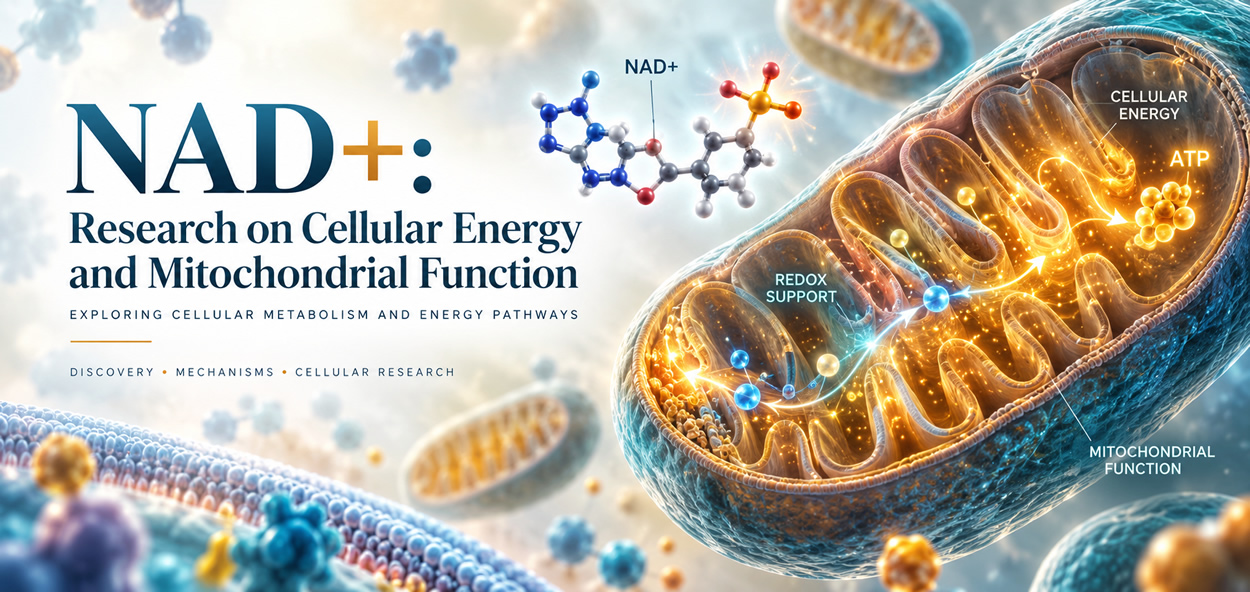
NAD+, or nicotinamide adenine dinucleotide, is a naturally occurring coenzyme found in every cell of the body and studied for its role in cellular energy, mitochondrial function, DNA repair, and metabolic signaling.
NAD+ participates in hundreds of biochemical reactions. One of its best-known roles is helping cells convert nutrients into usable energy, but it also interacts with enzymes involved in DNA repair, cellular stress responses, and communication between different metabolic pathways.
Research interest in NAD+ has increased because cellular levels tend to decline with age. Scientists are studying whether restoring or supporting NAD+ availability influences mitochondrial function, metabolism, tissue repair, and other biological processes associated with aging.
What Has NAD+ Research Studied?
NAD+ research spans cellular biology, animal models, human precursor studies, and smaller studies involving direct NAD+ administration.
- Cellular energy: NAD+ is essential to reactions that help cells convert carbohydrates, fats, and proteins into usable energy.
- Mitochondrial function: Researchers have studied how changes in NAD+ availability affect the mitochondria, the structures responsible for producing much of a cell's energy.
- DNA repair: NAD+ is used by enzymes involved in detecting and repairing damaged DNA.
- Cellular signaling: NAD+ interacts with enzymes such as sirtuins and PARPs, which participate in stress responses, metabolism, and genome maintenance.
- Aging biology: Researchers have examined the relationship between declining NAD+ levels and age-related changes in metabolism and cellular function.
Why Is NAD+ Important for Cellular Energy?
NAD+ plays a central role in cellular metabolism by carrying electrons between biochemical reactions.
During the breakdown of nutrients, NAD+ accepts electrons and is converted into NADH. NADH can then transfer those electrons into pathways involved in producing ATP, the molecule cells use as a primary source of energy.
This cycling between NAD+ and NADH is fundamental to energy production and is one reason NAD+ is closely connected with mitochondrial research.
NAD+ and Mitochondrial Function
Mitochondria depend on NAD+-related reactions to help generate energy efficiently.
Laboratory and animal studies have examined what happens when NAD+ levels decline and whether restoring NAD+ availability can influence mitochondrial performance.
Some preclinical studies have reported improvements in mitochondrial function, metabolic signaling, inflammatory markers, and tissue repair after increasing NAD+ availability.
These findings have contributed to interest in NAD+ as a broader metabolic research target rather than simply an energy-related molecule.
What Is the Relationship Between NAD+ and Aging?
Studies have reported that NAD+ levels decline in many tissues with age.
This decline has been associated with changes in mitochondrial function, DNA repair, inflammation, metabolism, and cellular stress responses.
Researchers are investigating whether supporting NAD+ metabolism can influence some of these age-related biological changes.
Animal research has produced encouraging findings in several tissues, but results in animals do not automatically establish the same effects in people.
NAD+ and DNA Repair
NAD+ is also involved in DNA maintenance.
Enzymes known as PARPs use NAD+ when responding to DNA damage. These enzymes help detect damaged genetic material and participate in signaling pathways involved in repair.
Because DNA damage accumulates over time and is associated with cellular aging, researchers have become interested in the relationship between NAD+ availability, DNA repair capacity, and long-term cellular function.
What Are Sirtuins?
Sirtuins are a family of enzymes that depend on NAD+ to function.
They participate in processes involving metabolism, mitochondrial activity, cellular stress responses, gene regulation, and DNA maintenance.
Much of the interest in NAD+ and longevity biology comes from the relationship between NAD+ availability and sirtuin activity.
Laboratory and animal studies have examined whether changes in this pathway influence metabolic health and biological aging.
What Has Human Research Found?
Human research involving NAD+ has taken several different approaches.
The largest body of controlled human evidence involves precursor compounds such as nicotinamide riboside, or NR, and nicotinamide mononucleotide, or NMN. The body can use these compounds as building blocks to produce NAD+.
Human trials have consistently shown that these precursors can raise NAD+-related markers in blood and cells.
However, measurable functional outcomes have been less consistent. Studies examining physical performance, metabolism, energy, muscle function, and other endpoints have produced mixed results depending on the population and outcome being studied.
This distinction is important: increasing NAD+-related biomarkers has been demonstrated more consistently than producing a specific measurable improvement in human function.
What Research Exists on Direct NAD+?
Direct NAD+ administration has a smaller human research base than oral NAD+ precursors.
Small pilot studies have examined intravenous NAD+ in human participants and have provided early information about tolerability and biological response.
These studies are useful for understanding direct NAD+ exposure, but they are much smaller than the human research programs involving NR and NMN.
As a result, the idea that direct NAD+ produces stronger or faster functional results than precursor compounds has not been established by large controlled human trials.
How Does Direct NAD+ Compare With NR and NMN?
| Approach | How It Works | Current Research Base |
|---|---|---|
| Direct NAD+ | Provides NAD+ directly | Limited controlled human research and small pilot studies |
| NR | Provides a precursor the body can use to synthesize NAD+ | Substantial human research showing increases in NAD+-related biomarkers |
| NMN | Provides another precursor used in NAD+ synthesis | Growing human research examining biomarkers and metabolic outcomes |
All three approaches are connected to the same underlying NAD+ pathway, but they are not supported by identical research.
NR and NMN currently have more controlled human trial data demonstrating their ability to increase NAD+-related biomarkers.
Direct NAD+ is often discussed as a way to bypass the conversion steps required by precursors, but whether this produces superior human outcomes has not been clearly demonstrated.
What Has Research Found About Neurological Function?
NAD+ metabolism has also been studied in neurological research.
One small clinical study involving people with ataxia-telangiectasia examined an NAD+ precursor and reported changes in neurological scores and immune-related markers.
This finding is specific to a rare genetic disorder and should not be assumed to represent the same effect in the general population.
It does, however, provide researchers with another model for studying how NAD+ metabolism may influence neurological and cellular function.
What Has Safety Research Reported?
Most controlled human safety information in this research area comes from studies of oral NAD+ precursors rather than direct NAD+ administration.
NR and NMN studies have generally reported relatively mild effects under the conditions studied, although findings vary across doses, populations, and study duration.
Research involving direct intravenous NAD+ is smaller. Reported effects during infusions have included nausea, flushing, headache, chest discomfort, and other temporary symptoms in some participants.
The available evidence is still limited for evaluating uncommon effects or the consequences of long-term repeated direct NAD+ exposure.
Why Is NAD+ of Research Interest?
NAD+ remains an important research target because it sits at the intersection of several fundamental cellular systems.
It participates in energy production, mitochondrial function, DNA repair, sirtuin activity, metabolic regulation, and cellular stress responses.
Research has established that NAD+ availability can be altered in humans, particularly through precursor compounds, but scientists are still investigating when those biochemical changes translate into meaningful changes in human health or physical function.
This difference between changing a biomarker and producing a measurable biological outcome remains one of the central questions in NAD+ research.
Research Sources
- Systematic reviews of human NAD+ precursor research
- Human trials involving nicotinamide riboside and nicotinamide mononucleotide
- Research examining NAD+ metabolism and mitochondrial function
- Studies involving NAD+, DNA repair, PARPs, and sirtuins
- Small pilot studies involving direct intravenous NAD+
- Preclinical research examining NAD+ and age-related cellular changes